Targeted Research
Survival of Cancer Patients
Survival analyses show how disease outcomes change over time and the extent of progress in cancer control. Cancer patient survival is an important indicator, reflecting both patient characteristics and the accessibility, organisation, and effectiveness of the healthcare system.
To date, the Slovenian Cancer Registry has published four reports on cancer patient survival in Slovenia, which include comments from clinicians. Survival analyses are also included in the Slovenian Cancer Registry’s annual reports.
Survival analyses of cancer patients enable international comparisons, showing Slovenia’s position relative to other countries and identifying areas for improvement. Key comparisons are published in the European Cancer Information System (ECIS) and in analyses from the CONCORD and EUROCARE projects.
Geographical Studies of Cancer Burden
As cancer emergence can be linked to environmental factors, geographical analyses play an important role in cancer epidemiology.
The SLORA web portal provides an overview of key indicators of the cancer burden down to the level of administrative units. However, experts or the general public may sometimes require a more detailed understanding of the cancer burden in smaller geographical areas. In such cases, specific studies are conducted using tailored methodological approaches. The results of these studies are provided to the client, and the final reports are usually also made available to the broader public.
In recent years, we have conducted the following studies, among others:
- an analysis of the potential impact of waste co-incineration on cancer burden and its possible association with exposure to selected pollutants in Anhovo (slo.), carried out within the framework of the Targeted Research Project V3-2236 titled “Assessment of the potential impact of incineration and co-incineration of waste on human health effects: a model study on the case of the Salonit Anhovo cement plant” (2025). We have also prepared a brief summary (slo.) of the process and results of the study mentioned above and published two scientific papers (1, 2).
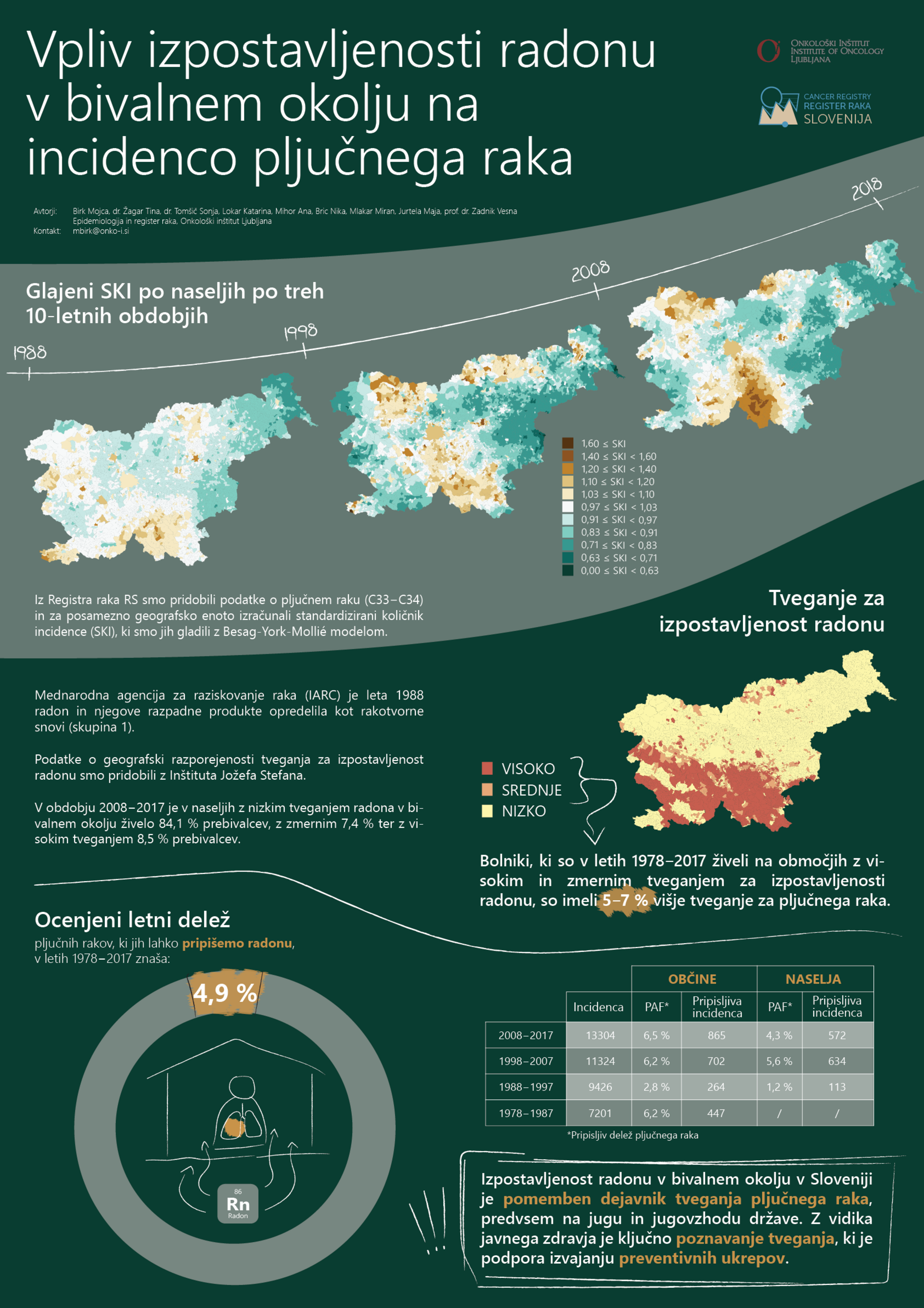
- a report and scientific paper of the analysis of the impact of radon exposure on lung cancer incidence in Slovenia (slo.), commissioned by the Ministry of Health of the Republic of Slovenia and Slovenian Radiation Protection Administration (2022);
- a report and scientific paper the geographic analysis of the cancer burden among children and adolescents in Slovenia, including a risk assessment of low-frequency magnetic field sources near power lines and transformer stations (slo.), carried out within the framework of the Targeted Research Project V3-1718, “Health risk assessment for exposures of children to low frequency electric and magnetic fields in Slovenia” (2020);
- a study on cancer incidence in the Dravsko polje (slo.) (2019);
- at the initiative of the Institute of Public Health Celje analysis of the cancer burden in Celje and Šentjur pri Celju administrative units (slo.), with an emphasis on the impact of heavy metals pollution (2011);
- at the initiative of the Institute of Public Health Novo Mesto geographical analysis of the cancer incidence in the Bela Krajina and surrounding areas (slo.), focusing on possible excess cancer incidence due to exposure to PCBs (2011);
- at the initiative of the Institute of Public Health Novo Mesto analysis of the burden of cancer in the Dolenjske Toplice municipality (slo.) (2011);
- at the initiative of the Ministry of Health and the Institute of Public Health Ljubljana analysis of the cancer burden in Zasavje region (slo.), with an emphasis on the impact of major industrial polluters (2008);
- at the initiative of the Agency for Radioactive Waste Management of Republic of Slovenia detailed analysis of the cancer burden in the Brežice municipality (slo.), with an emphasis on the difference in the risk before and after Krško nuclear power plant is in operation (2006).
Cancer Surveillance During the COVID-19 Epidemic – the onKOvid Portal
During the COVID-19 epidemic, driven by the need to monitor its impact on oncology care in Slovenia in real time, we established the onKOvid portal, through which we tracked selected indicators of the cancer burden and the care of cancer patients on a monthly basis from 2019 to 2023. The portal enabled the early identification of potential deviations in diagnosis, treatment and other key activities, thereby providing important information for expert decision-making and the adjustment of response measures during the epidemic.
Following the end of the COVID-19 pandemic, the onKOvid portal is no longer actively updated. Key findings from monitoring the impact of the COVID-19 pandemic on oncology in Slovenia are presented in two scientific articles (1, 2).